
A doctor does not hand you pills at the door.
They examine you, name the cause, write the prescription, and tell you to call in the morning. LeaderScale runs your managers through the same loop every week, on the behavior that is actually costing you revenue.
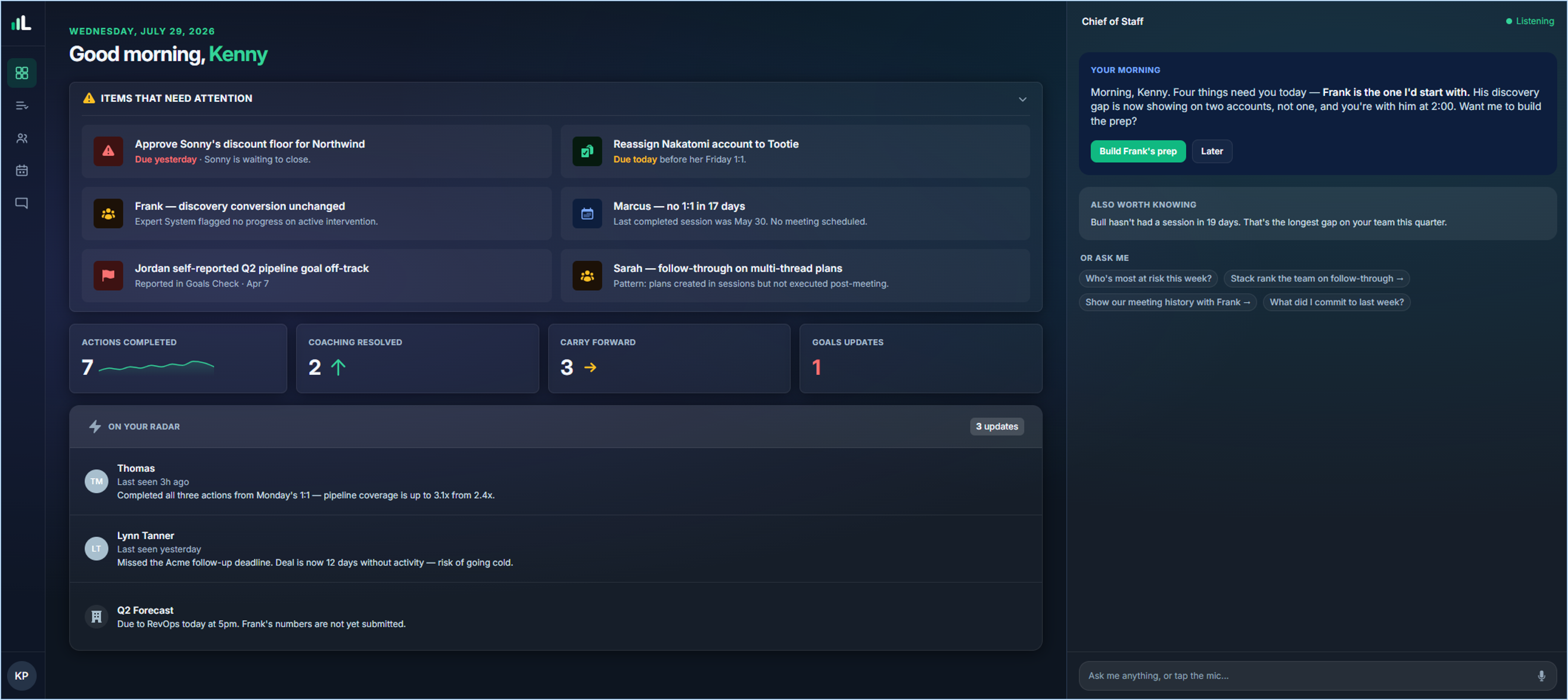
Four moves, repeated until the number changes.
DIAGNOSE
Find the behavior at root cause.
A missed quota is a symptom. So is a long sales cycle, a thin pipeline, and a rep who suddenly goes quiet. Treating the symptom gets you a pep talk and a spreadsheet.
LeaderScale reads the signals across your calls and your CRM, then works backward to the behavior producing them. It asks why until the answer is something a manager can actually coach.
Toyota called it the Five Whys. We built it into the console.PRESCRIBE
Hand the manager the exact next move.
Awareness without a prescription just makes a manager anxious. Every diagnosis arrives with a specific action for a specific rep, sized to fit one conversation.
The manager walks into the 1:1 knowing what to open with, which call to pull up, and what good looks like when the rep tries it.
REINFORCE
Build the skill, not just the awareness.
Knowing is not doing. A rep who understands a concept in a meeting will still default to habit under pressure on a live call.
LeaderScale moves each rep up a ladder: consume the idea, comprehend it, practice it somewhere safe, then apply it in front of a customer. The manager runs the ladder, so the reinforcement comes from a person the rep answers to.
FOLLOW UP
Confirm the pain went away.
Most coaching tools stop at the recommendation and never check the outcome. That is the part that turns advice into behavior change.
The following week, LeaderScale checks whether the behavior moved and tells the manager whether to double down or change the prescription. Take two of these and call me in the morning.
Effort and effectiveness need opposite prescriptions.
Two reps miss the same number. Coaching them the same way makes one of them worse.
They are not doing enough of the right activity.
Low call volume, thin prospecting, avoidance of the hard outreach. The fix is accountability, structure, and a manager who inspects what they expect.
Coach this one with more activity and the number moves.
They are working hard at the wrong technique.
Plenty of calls, weak discovery, a demo that starts before anyone agreed on the problem. Telling this rep to make more calls just multiplies a broken motion.
Coach this one with skill work and the number moves.
LeaderScale tells the manager which one they are looking at before the coaching starts.
From heard it once to does it under pressure.
Consume
The rep encounters the idea and can repeat it back.
Comprehend
They can explain when it applies and why it works.
Practice
They run it somewhere the stakes are low and the feedback is fast.
Apply
They use it on a live call and it holds up under pressure.
Why a generic AI tool cannot do this.
Real-time prompts make an automaton.
A dozen tools will feed a rep lines through an earpiece mid-call. A person under pressure can barely hear it, and reading a script is not the same as owning a skill.
Software cannot hold anyone to anything.
AI can flag a gap and suggest a fix. It cannot notice that a rep is discouraged, adjust the ask, or follow up in a way the rep feels obligated to honor.
Most people do not self-correct.
A small share of any team will take a flagged insight and fix themselves. Everyone else needs a manager who turns the insight into a commitment.
Ask it to fix a rep and it writes something plausible from the open internet. It cannot tell an effort gap from an effectiveness gap, and it has never seen what actually moved a number on your team.
Never lets the model invent the coaching. It reads the situation, then pulls the next move from over a thousand validated interventions, each mapped from a root cause to the outcome it produced.
The manager is the instrument. The AI is the diagnostic. LeaderScale points its intelligence at the manager, who keeps the relationship, the judgment, and the authority, and stops guessing about where to spend their coaching hours.
Gong hears the call. Somebody still has to run the team.
Conversation intelligence scores the rep talking to a prospect. LeaderScale works one layer up, on the leader talking to the team. Every tool in your stack does a real job. Four of them, stacked, still leave the last one open.
Capture the data. They hold the history and answer questions you already knew to ask.
Analyze the conversation and the deal. They surface the insight and hand it back to you as a report.
Move messages between people. They make talking easy and leave the content of the talk up to you.
Tells each manager where to focus, why it matters, what to do next, and whether it worked. Advice to action to accountability.
Revenue intelligence aims at the sales call.
Gong and Clari listen to a rep sell and grade the result. That's useful, and it produces a scorecard nobody is accountable for acting on. Enablement platforms like Mindtickle and Seismic push curriculum at the same rep, on a schedule that has nothing to do with the deal in front of them.
LeaderScale aims at the coaching conversation.
We read the same signals and point them somewhere else, at the manager who has the relationship, the judgment, and the authority to change what happens next week. The prescription arrives before the 1:1, and the system checks whether the behavior moved.
Insight is cheap now. Follow-through is the scarce part. A recorded call becomes revenue the moment a manager does something specific with it. That handoff is the layer LeaderScale owns, and it's the one your stack leaves empty.
Fix the thing that's actually broken.
LeaderScale is the Manager Operating System that gives every manager an AI Chief of Staff so they stop guessing and start coaching more people with confidence, consistency, and real accountability.